
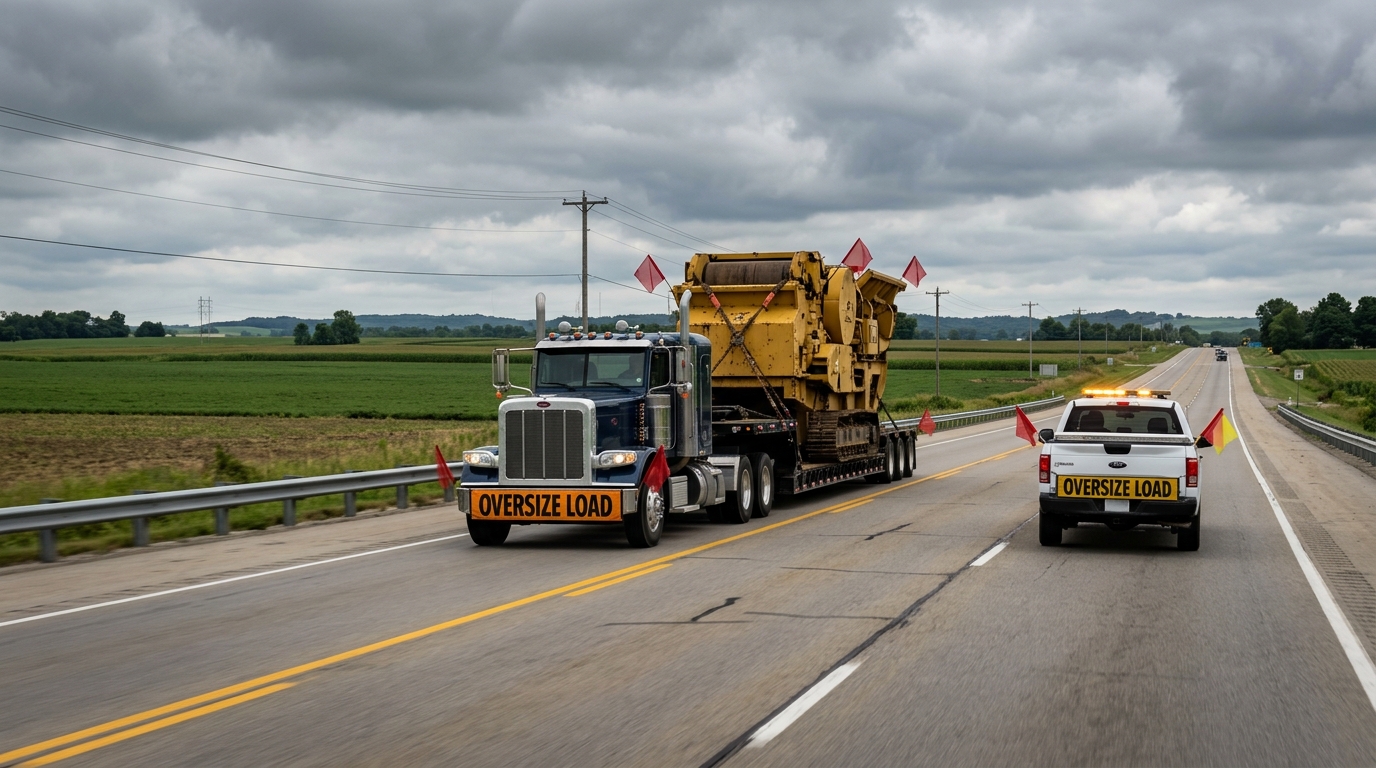
Ohio: Where Midwestern Freight Comes Together
Ohio is not just another state on a multi-state haul. A lot of the time, it is the state. I-70, I-71, I-75, I-77, and I-80/90 put Cincinnati, Columbus, Cleveland, and Toledo right in the middle of the freight lanes connecting the East Coast to the Midwest and the Great Lakes to the South.
All that freight means Ohio runs a specific, well-enforced permit system. The Ohio Department of Transportation (ODOT) issues Special Hauling Permits for state highways, but there is one big catch for out-of-state carriers: the Ohio Turnpike is a separate authority with its own permits. Miss that and you can have a valid ODOT permit in the cab and still be running illegally on I-80.
This guide covers what Ohio requires for oversize and overweight moves in 2026: the legal limits, superload thresholds, escorts, travel restrictions, Turnpike rules, fees, and the mistakes that cost carriers the most.
Ohio Legal Weight Limits
On the Interstate system, Ohio uses the federal limits:
- Single axle: 20,000 lbs
- Tandem axle: 34,000 lbs
- Two or more consecutive axles: set by the federal bridge formula
- Gross vehicle weight: 80,000 lbs
Because the bridge formula applies, your legal gross weight may be lower than 80,000 lbs depending on how your axles are spaced. Carriers who assume 80,000 lbs is always legal are the ones who get written up for bridge formula violations.
Off the Interstate
On roads that are not part of the Interstate system, Ohio law uses its own formulas based on axle spacing. The single axle limit is still 20,000 lbs, and two axles spaced 4 feet or less apart are limited to 24,000 lbs. Ohio applies whichever method (federal or state) gives the higher gross limit, and the 80,000 lb gross cap still applies.
Posted Weight Reductions
Some roads and bridges carry posted weight limits that are lower than the statewide numbers. These are especially common on county and township roads, and some are seasonal. Your permit does not override a posted reduction. ODOT tells permit holders to obey posted reductions and to call the permit office right away if their route includes one.
Ohio Legal Dimension Limits
Ohio’s legal limits without a permit:
- Width: 8 feet 6 inches (102 inches), including load
- Height: 13 feet 6 inches, with or without load
- Semitrailer (tractor-semitrailer combination): 53 feet
- Each trailer in a double (tractor-semitrailer-trailer): 28 feet 6 inches
- Most other combinations: 65 feet overall
- Single vehicle: 50 feet
Safety devices like mirrors, lights, and tarp hardware that sticks out 3 inches or less per side don’t count toward width. Anything over these limits needs an Ohio Special Hauling Permit before it moves on public roads.
Routine Permits vs. Superloads
ODOT sorts permit loads into two groups.
Routine Permits
Loads over legal limits but within ODOT’s routine envelope. These are applied for through the Ohio Hauling Permit System (OHPS), ODOT’s online permit portal.
Superloads
ODOT considers a load a superload if it has any of these:
- Gross weight over 120,000 lbs
- Axle or axle group weights over ODOT’s routine limits
- Overall width over 14 feet
- Overall height over 14 feet 6 inches
Overweight superloads go through ODOT’s bridge analysis, and the vehicle has to meet ODOT’s axle spacing and group weight rules before a permit is issued. If an application fails the analysis, you will need more axles or components to spread out the weight. Superloads take longer than routine permits, so build in extra lead time.
The Ohio Turnpike: A Separate Permit System
This is the most important Ohio-specific fact for out-of-state carriers: the Ohio Turnpike (I-80/I-90 across northern Ohio) is run by the Ohio Turnpike and Infrastructure Commission (OTIC), not ODOT.
- An ODOT permit covers state routes only. Even if ODOT routes you onto the Turnpike, the ODOT permit does not authorize Turnpike travel.
- If your route uses the Turnpike, you will usually need an OTIC permit as well.
- If your trip is only on the Turnpike, you do not need an ODOT permit.
Turnpike Rules Worth Knowing
- Legal gross weight is 90,000 lbs on the Turnpike without a permit, as long as axle weights are legal.
- Turnpike permits are one-way, single-trip only. OTIC does not issue annual or blanket permits.
- Small oversize loads can get a permit at the entry toll plaza if they are 11 feet wide or less, 112 feet long or less, and 14 feet tall or less. A $25 processing fee is added for permits issued at the plaza.
- Apply in advance if your load is wider than 11 feet, longer than 112 feet, over 90,000 lbs gross, or has overweight axles.
- Daylight-only travel applies to Turnpike loads over 10 feet wide and 90 feet long, or with a rear overhang over 4 feet. Rear overhangs over 15 feet also need a rear escort.
- Holiday and construction restrictions are published by OTIC each year and can block certain loads on certain days.
Ohio Escort Vehicle Requirements
Ohio’s escort rules are based on the permitted dimensions of the load:
| Length over 90 feet | 1 rear escort |
| Width over 13 feet | 1 lead escort (rear on multi-lane highways) |
| Height over 14’6" | 1 lead escort with height-sensing device |
| Width over 14’6" | 1 lead and 1 rear escort |
| Height over 14’10" | 1 lead and 1 rear escort |
| More than one of the first three conditions | 1 lead and 1 rear escort |
Loads over 14 feet 10 inches tall also have to coordinate the move with the owners of overhead signs, signals, and utilities along the route.
Police Escorts
ODOT can require a police or Highway Patrol escort on any move it decides is likely to cause delay or a hazard to the public, or damage to roads or bridges. If your permit calls for one, the carrier is responsible for arranging it.
Escort Vehicle Equipment
When a permit requires escorts, each private escort vehicle needs:
- A yellow “OVERSIZE LOAD” sign with black letters, 5 feet long by 12 inches high, with 8-inch letters
- A roof-mounted amber flashing or rotating light visible from at least 1,000 feet in normal daylight
- Radio communication with the truck driver
- An outside mirror on each side, a full-size spare tire with jack and lug wrench
- A safety vest or jacket and hard hat for flagging, plus a STOP/SLOW paddle
- An ABC fire extinguisher, at least four flares, and three reflective triangles
- A height-sensing device when escorting loads over 14 feet 6 inches tall
The escort must be a car, SUV, van, or pickup rated one ton or less. It can’t tow a trailer. Escort drivers must be at least 18 with a valid driver’s license. Ohio does not require state escort certification, but other states on your route may, so check every state before the move.
Flags, Signs, and Lights on the Load
- Warning flags: 18 inches square, red or orange, at the widest points and each corner of an overwidth load. Over-length loads, and loads with 4 feet or more of rear overhang, need flags at the rear.
- “OVERSIZE LOAD” signs: at least 7 feet long by 18 inches high, yellow with black 10-inch letters, on the front and rear. They are required on loads that are over legal length, 10 feet wide or more, or taller than 14 feet 6 inches.
- Headlights must be on during any oversize movement.
Travel Restrictions for Ohio Oversize Loads
Daylight Hours
Unless your permit says otherwise, oversize loads may move during daylight hours, seven days a week. Ohio defines daylight as one-half hour before sunrise until one-half hour after sunset.
Weekend Afternoons (Loads Over 12 Feet Wide)
Loads over 12 feet wide cannot move:
- Saturday from 3 p.m. until one-half hour before sunrise Sunday
- Sunday from 3 p.m. until one-half hour before sunrise Monday
- Friday from 3 p.m. until one-half hour before sunrise Saturday, April 1 through November 30
Weekday Rush Hours in Metro Counties (Loads Over 12 Feet Wide)
Loads over 12 feet wide cannot move 6:30–9:00 a.m. or 4:30–6:00 p.m., Monday through Friday, in these 22 counties: Butler, Clermont, Cuyahoga, Delaware, Fairfield, Franklin, Geauga, Hamilton, Lake, Licking, Lorain, Lucas, Madison, Mahoning, Medina, Montgomery, Pickaway, Stark, Summit, Union, Warren, and Wood.
That covers the Columbus, Cleveland, Cincinnati, Dayton, Toledo, Akron, Canton, and Youngstown areas, so plan your timing around them.
Holidays
No oversize movement on New Year’s Day, Memorial Day, Independence Day, Labor Day, Thanksgiving, or Christmas, or on the holiday weekends around them. The restriction starts at noon the day before and runs until one-half hour before sunrise the day after the holiday or holiday weekend.
Overweight-Only Loads
If your load is overweight but within legal dimensions, Ohio does not restrict your travel days or hours, as long as you can move without blocking normal traffic.
Weather
Your permit is void whenever road, weather, or traffic conditions make travel unsafe, as determined by the Ohio State Highway Patrol or local law enforcement. Mobile homes, manufactured buildings, and office trailers can’t move when winds go over 25 mph on the road or 15 mph on bridges.
How to Apply for an Ohio Special Hauling Permit
Step 1: Get Registered
Before applying, the carrier must register in the Ohio Hauling Permit System, and the carrier’s insurance company must register too and submit Form OS-32 for the carrier.
Step 2: Get Exact Dimensions and Your Route
Ohio permits are route-specific. You will need:
- Gross weight and every axle weight, plus axle spacings
- Width at the widest point, including the load
- Height from the ground to the highest point, including tarps and tie-downs
- Overall length, including overhang
- Origin, destination, and the full route
Step 3: Apply
You can apply through the Ohio Hauling Permit System (OHPS), through a permit service, with a paper Form OS-1, or in person at the ODOT Hauling Permit office in Columbus.
Step 4: Add the Turnpike Permit if Needed
If any part of your route uses the Ohio Turnpike, get your OTIC permit too. Small oversize loads can get one at the toll plaza. Everything else should apply in advance.
Step 5: Line Up Escorts
Check your permit conditions and line up your escorts. If a police escort is required, start arranging it as soon as the permit is issued.
Step 6: Carry the Permit and Form OS-1A
The driver must carry a clean, legible copy of the permit along with Form OS-1A (ODOT’s limitations and provisions sheet, both sides) and show them on request to law enforcement or ODOT staff.
Ohio Permit Fees
ODOT permit fees are set in the Ohio Administrative Code. Every permit has a basic processing charge plus a surcharge based on the load. One-way trip surcharges:
| Width up to 14’ and/or height up to 14’6" | $55 | $35 |
| Width over 14’ and/or height over 14’6" | $125 | $65 |
| Overweight up to 120,000 lbs | $125 | $65 |
| Overweight over 120,000 lbs | $125 + $0.04 per ton over 60 tons, per mile | $65 + $0.04 per ton over 60 tons, per mile |
| Emergency trip | $240 | $115 |
If a load is both overweight and oversize, you pay one processing charge plus the overweight surcharge, not both surcharges.
Continuing and Annual Permits
For carriers who run similar loads through Ohio regularly, ODOT offers continuing and annual permits. For example, a continuing oversize permit (up to 14 feet wide and 14 feet 6 inches tall) carries a $240 surcharge, and an annual overweight permit (up to 120,000 lbs) carries a $1,960 surcharge. If you move the same configuration often, these can cost a lot less than buying a single-trip permit every time.
Revisions and Special Work
Permit revisions cost extra ($10, or $50 for superload-sized permits). If a move needs special traffic control or engineering work from ODOT, the carrier pays those costs too.
Ohio Turnpike Fees
OTIC charges its own permit fees on top of tolls. For 2026, they are $25 for overdimension loads (waived if overweight fees apply), $135 for overweight up to 120,000 lbs, and $135 plus a ton-mile charge above 120,000 lbs.
Common Mistakes Ohio-Bound Carriers Make
Forgetting the Turnpike Permit
This is the most common and most expensive Ohio mistake. Your ODOT permit does not cover I-80/I-90 on the Turnpike. If your route touches the Turnpike, plan for both permits.
Running Wide Loads at the Wrong Time
Ohio’s 12-foot rules for weekend afternoons and metro rush hours catch a lot of drivers who thought “daylight” was the only limit. A load that’s over 12 feet wide and rolling into Franklin County at 4:45 p.m. on a Tuesday is breaking the rules.
Leaving the Permitted Route
Your permit covers specific highways between specific points. County roads, township roads, and city streets that aren’t part of the state highway system need permission from those local authorities. That includes the first and last mile to a job site or plant.
Routing With GPS Instead of Your Permit
Regular GPS doesn’t know your load’s height or weight. Low bridges and weight-restricted structures are common on older Ohio state routes. Follow the route on your permit, not your navigation app.
Getting the Height Wrong
Height is measured from the ground to the highest point of the load, including tarps, chains, and anything on top. An extra few inches you didn’t measure can mean the permit doesn’t match the load, and in Ohio that makes the permit void.
Going Over Your Permitted Axle Weights
If you go over a permitted axle or axle group weight by more than 2,000 lbs, or go over your permitted gross weight at all, your Ohio permit is void. Smaller axle overages have to be fixed before the load moves on.
Working With a Permit Service for Ohio Moves
For experienced carriers with routine loads, Ohio’s system works well. Trouble usually shows up at the edges: Turnpike coordination, superload bridge analysis, travel-time windows in metro counties, and multi-state moves where Ohio is one leg of several.
Custom Permits handles Ohio oversize and overweight permits as single-state permits or as part of a multi-state package. For routine loads, you can order directly at easypermits.custompermits.com. Enter your load details and route, and we’ll take it from there. For superloads, Turnpike coordination, or loads that are both oversize and overweight, give the team a call and we’ll sort out what Ohio needs along with every other state on your route.
The Bottom Line on Ohio Permits
- Ohio Turnpike = separate permit. An ODOT permit doesn’t cover it.
- Superloads start at 120,000 lbs, 14 feet wide, or 14’6" tall. Apply early.
- Escorts start at 13 feet wide, 14’6" tall, or 90 feet long.
- Over 12 feet wide? Watch the clock. No weekend afternoons, and no weekday rush hours in the 22 metro counties.
- No oversize moves over the six major holidays, starting at noon the day before.
Get those right and you’ll move through Ohio without trouble. Have questions about a specific load or route? Custom Permits is here to help.
Need Permits? We've Got You Covered.
Whether you need a single trip permit or manage a fleet running 48 states, Custom Permits has been getting it done since 1977. Order online or give us a call — we'll take care of you.