
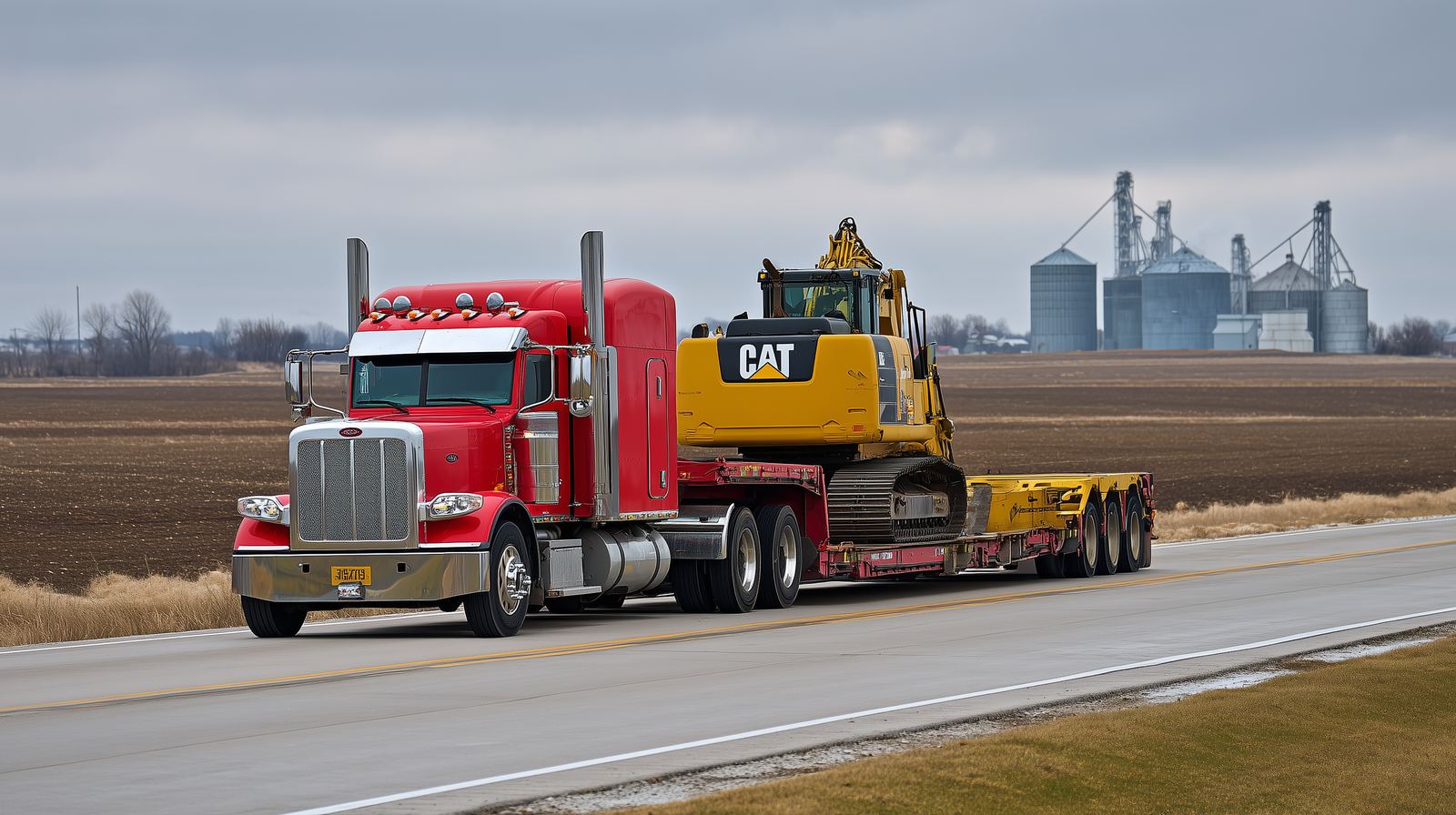
Illinois Doesn’t Play Around With Overweight Trucks
If you’ve ever run heavy loads through the Midwest, you already know that Illinois takes overweight enforcement seriously. The state sits at the crossroads of American freight — I-80, I-55, I-57, I-90, I-94 all converge here — and the Illinois Department of Transportation (IDOT) has the infrastructure to match that traffic volume with enforcement.
In 2025 alone, Will County courts processed hundreds of overweight truck violations under 625 ILCS 5/15-111, with individual fines running into the thousands. Illinois uses fixed and portable weigh stations, and enforcement officers are known for pulling trucks off the road for spot checks on secondary highways where carriers sometimes try to avoid scales.
The bottom line: if your truck exceeds legal weight limits on any Illinois highway, you need a permit. Getting one isn’t complicated — but understanding which permits you need, how the system works, and where carriers make expensive mistakes is what separates a smooth trip from a four-figure fine.
Illinois Weight Limits: Know Your Numbers
Before you can figure out whether you need a permit, you need to know what’s legal without one. Illinois follows federal bridge formula guidelines but has its own specific thresholds that every carrier should have memorized.
Legal Limits Without a Permit
| Single axle | 20,000 lbs |
| Tandem axle (2 axles, 4–8 ft spacing) | 34,000 lbs |
| Tridem axle (3 axles, 8–10 ft spacing) | 42,000 lbs |
| 2-axle vehicle (GVW) | 36,000 lbs |
| 3-axle vehicle (GVW) | 60,000 lbs |
| 4-axle vehicle (GVW) | 80,000 lbs |
| 5-axle vehicle (GVW) | 80,000 lbs |
| 6-axle vehicle (GVW) | 80,000 lbs |
Here’s what catches a lot of carriers: a 5-axle and a 6-axle truck have the same 80,000 lb gross limit in Illinois. The extra axle doesn’t buy you more gross weight — it affects your axle spacing calculations and bridge formula compliance, but the GVW cap stays the same.
The Bridge Formula Matters
Illinois applies the Federal Bridge Formula to evaluate whether your axle weights and spacings are legal. Even if your gross weight is under 80,000 lbs, you can still be overweight on a specific axle group. A 5-axle truck at 79,500 lbs GVW with too much weight concentrated on the drives will get cited just as fast as a truck at 82,000 lbs.
When you’re loading, think about distribution — not just total weight. Illinois enforcement officers check individual axle groups, not just the scale total.
How to Get an Illinois Overweight Permit Through ITAP
IDOT runs all overweight permitting through the Illinois Transportation Automated Permit system (ITAP). It’s an online portal, and for routine overweight permits, it’s actually one of the better state systems out there — most permits issue automatically within minutes.
Step 1: Set Up Your ITAP Account
Before you can apply for anything, you need an ITAP account. Registration requires your company name, USDOT number, and contact information. Plan to set this up before you need a permit — don’t wait until you’ve got a load sitting in a shipper’s yard.
Step 2: Enter Your Vehicle and Load Information
For an overweight permit, ITAP needs:
- Vehicle configuration — number of axles, spacing between each axle (measured center to center)
- Axle weights — individual weight on each axle or axle group
- Gross vehicle weight — total combined weight of truck, trailer, and load
- Vehicle dimensions — overall length, width, and height (especially if you’re also oversize)
- Origin and destination — specific addresses in Illinois or entry/exit points at the state line
- Travel dates — when you’ll be making the move
Step 3: Route Review and Permit Issuance
ITAP automatically checks your route against bridge tolerances, active construction zones, height clearances, and other safety restrictions. If everything clears, your permit prints immediately. If there’s a conflict — say a bridge on your route can’t handle your axle weights — ITAP will flag it and you may need to adjust your route or contact IDOT for an alternative.
What ITAP Doesn’t Cover
Here’s where it gets tricky. ITAP only covers state highways under IDOT jurisdiction. If your route includes any of the following, you need additional permits:
- Illinois Tollway — requires a separate permit from the Tollway’s Commercial Vehicle Permit System
- Local roads — county highways, township roads, and city streets require permission from the local jurisdiction
- Interstates through Chicago metro — some specific routes have additional restrictions during peak traffic hours
A carrier hauling a 95,000 lb load from Joliet to Rockford might need an IDOT permit for the state highways, a Tollway permit for I-88, and local permission for the last two miles to the delivery site. Miss any one of those and you’re exposed to fines on that segment.
Illinois Tollway Overweight Permits: The Second Permit Nobody Tells You About
This is the single most common mistake carriers make in Illinois. They get their IDOT permit through ITAP, assume they’re covered statewide, and then get pulled over on the Tollway without the right paperwork.
The Illinois Tollway is a separate authority from IDOT. It operates I-88, I-294, I-355, I-90 (west of I-39), and several other major routes around Chicago. If your overweight load touches any Tollway road, you need their permit in addition to your IDOT permit.
Tollway Permit Weight Thresholds
The Tollway’s routine permit limits align with IDOT’s but have their own fee structure:
- Single axles: up to 25,000 lbs with a permit (routine issuance)
- Tandem axles: up to 48,000 lbs with a permit
- Tridem axles: up to 60,000 lbs with a permit
- 5-axle GVW: up to 100,000 lbs with a permit
- 6-axle GVW: up to 120,000 lbs with a permit
Anything beyond these limits is classified as a superload on the Tollway and requires special engineering analysis. Contact the Tollway at least three business days before a superload movement — they need time to analyze bridge impacts on your specific route.
How to Get a Tollway Permit
- Get your IDOT permit number from ITAP first — the Tollway requires it
- Register on the Tollway Commercial Vehicle Permit System
- Submit your application with vehicle specs, IDOT permit number, and Tollway route
- Routine permits are typically issued by email the same day
Overdimension permits (width, length, height) on the Tollway cost $15 each. Overweight permit fees vary based on your weight and configuration.
Superloads in Illinois: When You Exceed Routine Permit Limits
Not every overweight load qualifies for routine permitting. When your gross weight, axle weights, or dimensions exceed the routine thresholds, Illinois classifies your move as a superload — and the process changes significantly.
What Makes a Superload?
In Illinois, you’re in superload territory when:
- Gross vehicle weight exceeds 120,000 lbs (or the routine limit for your axle configuration)
- Any single axle exceeds 25,000 lbs
- Width exceeds 14 feet 6 inches
- Height exceeds 14 feet 6 inches on state routes (lower on Tollway)
- Overall length exceeds 120 feet
The Superload Process
Superloads require manual review by IDOT engineers. Here’s what to expect:
- Submit your application through ITAP — same system, but it routes to the engineering team instead of auto-issuing
- Bridge analysis — IDOT engineers evaluate every bridge on your proposed route against your specific axle weights and spacings. This takes 3 to 5 business days minimum.
- Route modifications — if a bridge can’t handle your load, IDOT will suggest alternative routes or require additional axles to redistribute weight
- Escort requirements — most superloads in Illinois require one or two escort vehicles. Loads over 14 feet wide or over 120 feet long typically need front and rear escorts.
- Time-of-day restrictions — superloads in urban areas (especially the Chicago metro) are often restricted to nighttime or weekend movement only
A construction company moving a 150,000 lb transformer from East St. Louis to Springfield on a 13-axle trailer should budget at least a week for the permitting process. The bridge analysis alone can take 5 business days, and if IDOT requires route changes, that resets part of the clock.
Seasonal Weight Restrictions: The Spring Surprise
Every year from roughly mid-February through May, Illinois enforces seasonal posted weight limits on certain state highways. This catches carriers who’ve been running the same route all winter without issues.
During spring thaw, the ground under roadways softens. Heavy trucks that were fine in January can now cause structural damage to the road surface. IDOT responds by posting reduced weight limits — sometimes dropping to 60% of normal legal limits on affected routes.
The critical thing to understand: Your overweight permit does not override a posted weight restriction. If your route includes a road posted at 48,000 lbs during spring thaw, your 80,000 lb permit is irrelevant for that segment. You need to find an alternate route that avoids posted roads, or wait until the restrictions are lifted.
Check the IDOT website for current posted road maps before planning any heavy moves during spring months. Running a posted road with an overweight load is one of the most expensive mistakes you can make — it combines overweight fines with posted road violation penalties.
Common Mistakes That Cost Carriers in Illinois
1. Skipping the Tollway Permit
We talked about this above, but it bears repeating because we see it constantly. Carriers get their IDOT permit and assume it covers the whole state. It doesn’t. The Tollway is a separate authority with separate permits. If your route touches I-88, I-294, I-355, or the western portion of I-90, you need a Tollway permit on top of your IDOT permit.
2. Ignoring Local Road Requirements
ITAP permits only cover state highways. The last mile from the state route to the job site or delivery point often involves county or municipal roads. Technically, you need permission from every local jurisdiction your overweight load crosses. In practice, this means calling the county highway department and sometimes the township road commissioner.
For a carrier delivering a 90,000 lb piece of construction equipment to a job site 3 miles off the state highway, those 3 miles of county road are completely uncovered by the IDOT permit. If a county officer stops you — and in rural Illinois, they absolutely will — you need to show local authorization.
3. Running Posted Roads During Spring Thaw
Every spring, carriers who don’t check for seasonal postings end up with violations. A 5-axle truck permitted at 95,000 lbs running a road posted at 48,000 lbs is not just 15,000 lbs over the normal 80,000 lb limit — they’re 47,000 lbs over the posted limit. The fines scale accordingly, and they scale fast.
4. Wrong Axle Spacing Information on the Application
ITAP uses your axle spacings to calculate bridge formula compliance and route your permit around bridges that can’t handle your configuration. If you enter the wrong spacings — even by a foot or two — your permit may route you over a bridge that isn’t actually rated for your real configuration. That’s a safety issue and a compliance issue. Measure your axle spacings accurately, center of axle to center of axle.
5. Not Accounting for Fuel and Equipment Weight
Your permit weight needs to reflect the total loaded weight of the vehicle — including fuel, chains, binders, tarps, and any other equipment on the truck. A carrier who permits at 92,000 lbs but rolls across the scale at 93,200 lbs because they filled up at the fuel stop is now overweight on their permit. Scale your truck loaded and ready to roll, then permit to that weight.
Illinois Overweight Permit Fees
IDOT doesn’t publish a simple flat fee schedule for overweight permits — fees vary based on your gross weight, axle configuration, route length, and whether you need single-trip or annual permits.
General Fee Ranges
- Routine single-trip overweight (80,001–100,000 lbs, 5+ axles): $20–$75
- Heavier single-trip (100,001–120,000 lbs): $50–$200
- Superload (120,000+ lbs): $200+ plus engineering analysis fees
- Annual overweight permits (for carriers who run heavy regularly): Available for certain weight ranges, with fees based on the number of trips and weight bracket
- Tollway overweight permits: Separate fee schedule, varies by weight
For carriers running heavy loads through Illinois regularly, an annual permit can save significant money compared to buying single-trip permits every week. Talk to IDOT or your permit service about whether your volume justifies an annual.
FAQ
Q: How much does an Illinois overweight permit cost? A: IDOT overweight permit fees vary based on your gross vehicle weight and the number of axles. A standard single-trip overweight permit for a 5-axle truck running between 80,001 and 100,000 lbs typically costs between $30 and $75. Superloads requiring engineering analysis cost significantly more due to bridge analysis fees. Illinois Tollway overweight permits are separate and cost an additional fee on top of the IDOT permit.
Q: Do I need a separate permit for the Illinois Tollway? A: Yes. An IDOT overweight permit does not cover the Tollway. You must obtain a separate permit from the Illinois Tollway’s Commercial Vehicle Permit System (CVPS). You’ll need your IDOT permit number first — the Tollway requires it before issuing their permit.
Q: What is the legal weight limit in Illinois without a permit? A: The standard legal gross vehicle weight in Illinois is 80,000 lbs for a 5-axle combination vehicle. Single axles are limited to 20,000 lbs, and tandem axles (two axles spaced 4 to 8 feet apart) are limited to 34,000 lbs. Any weight above these thresholds requires an overweight permit.
Q: How fast can I get an Illinois overweight permit? A: Most routine overweight permits are issued immediately through the ITAP online system — often within minutes of submitting your application. Superload permits that require bridge analysis take a minimum of 3 to 5 business days. Custom Permits can process routine Illinois overweight permits same-day.
Q: What happens if I get caught overweight in Illinois without a permit? A: Illinois overweight fines are calculated per pound over the legal limit and escalate fast. For a truck running 5,000 lbs over without a permit, fines can easily exceed $1,500. At 10,000 lbs over, you’re looking at $3,000 or more. Repeat violations can result in vehicle impoundment and suspension of your operating authority in the state.
Q: Does Illinois have seasonal weight restrictions? A: Yes. Illinois enforces seasonal posted weight limits on certain state highways, typically during spring thaw from mid-February through May. During posted periods, weight limits on affected roads drop significantly — sometimes to 60% of normal limits. Overweight permits do not override posted weight restrictions. You must comply with the posted limit regardless of what your permit says.
Get Your Illinois Overweight Permit Handled Right the First Time
Between IDOT permits, Tollway permits, local road authorization, seasonal postings, and bridge formula calculations, running heavy in Illinois has more moving parts than most states. Get any one of them wrong and you’re looking at fines that dwarf the cost of doing it right.
Custom Permits processes Illinois overweight permits every single day — IDOT, Tollway, and everything in between. We know which routes clear fastest, which bridges flag certain configurations, and how to get your permit issued without the back-and-forth. Get in touch or call us at 614-351-1740, and we’ll get your heavy load moving through Illinois the right way.
Need Permits? We've Got You Covered.
Whether you need a single trip permit or manage a fleet running 48 states, Custom Permits has been getting it done since 1977. Order online or give us a call — we'll take care of you.