
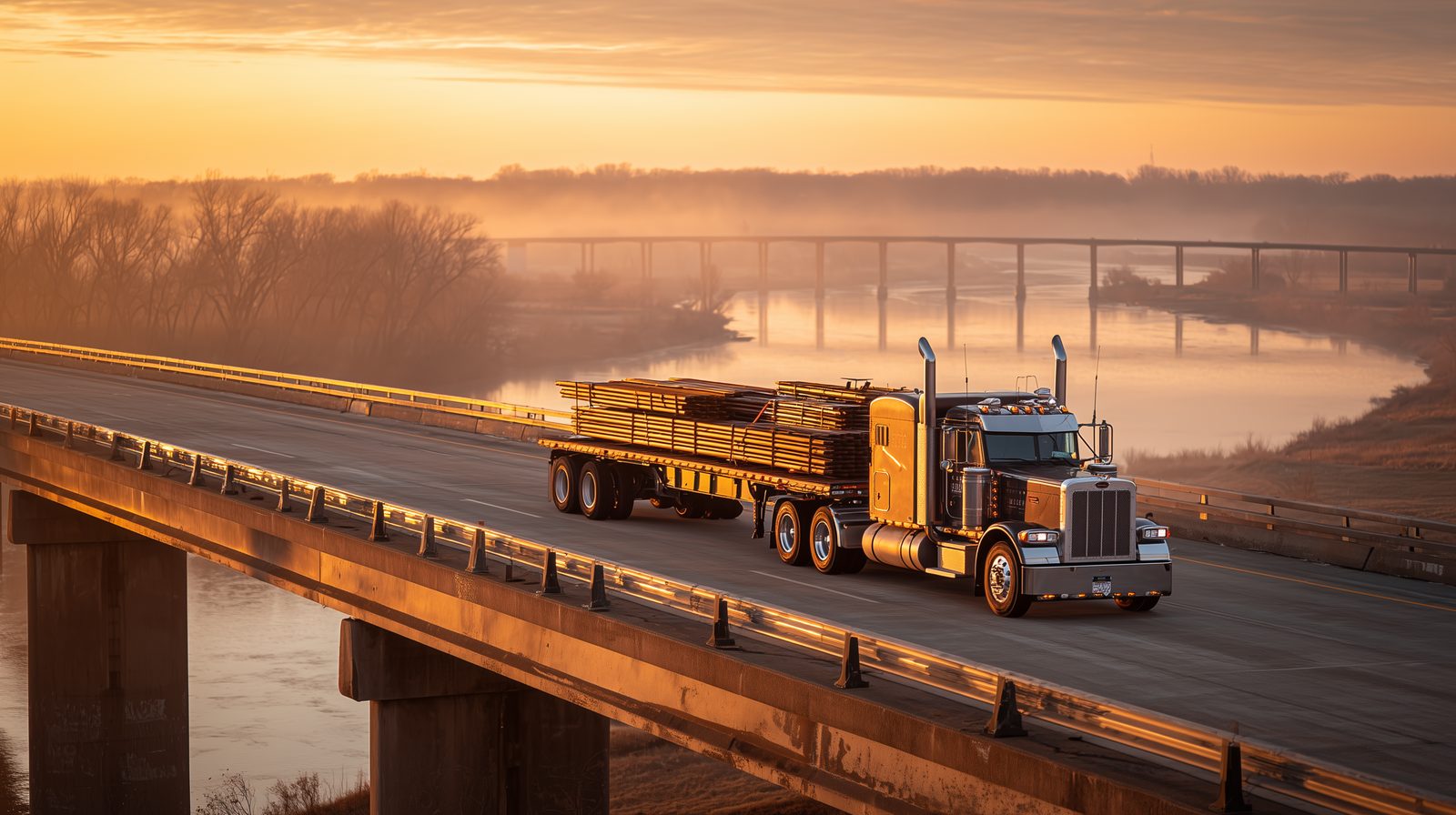
Running Heavy Means Running Legal — Or Paying the Price
With multiple Midwest states rolling out spring weight restrictions right now in March 2026, overweight enforcement is at a seasonal peak. If you’re hauling anything close to the limit — or over it — this is the worst possible time to be guessing about your permit situation.
Here’s the reality: the federal gross vehicle weight limit on Interstate highways is 80,000 pounds. But “federal limit” doesn’t mean “universal limit.” Every state sets its own rules for non-Interstate roads, and even on the Interstate system, the bridge formula can make you illegal at 78,000 lbs depending on your axle configuration. An overweight permit is your legal authorization to exceed those limits — and without one, you’re looking at fines that can run anywhere from $150 to over $16,000 depending on the state and how far over you are.
This guide covers how overweight permits work across the country, what each state actually requires, and the mistakes that drain money from carriers who should know better.
Federal Weight Limits and the Bridge Formula
Before you can understand overweight permits, you need to understand what “overweight” actually means under the law. The Federal Highway Administration sets the baseline:
- Single axle limit: 20,000 lbs
- Tandem axle limit: 34,000 lbs
- Gross vehicle weight (GVW): 80,000 lbs on the Interstate system
But those numbers don’t tell the whole story. The federal bridge formula (Formula B) determines the maximum weight allowed on any group of axles based on the number of axles and the spacing between them. It exists to protect bridges and road surfaces from concentrated loads.
The formula looks like this:
W = 500 × [(LN / (N-1)) + 12N + 36]
Where W is the maximum weight in pounds, L is the distance in feet between the outer axles of any group, and N is the number of axles in the group.
What this means in practice: a standard 5-axle tractor-trailer with 51 feet between the steer axle and the rear tandem can legally gross 80,000 lbs. But shorten that spacing — say your trailer has a shorter wheelbase — and the bridge formula might cap you at 77,500 lbs even though you’re under the 80,000 lb gross limit.
If your truck exceeds either the individual axle limits or the bridge formula calculation for any axle group, you need an overweight permit. Period.
How the Overweight Permit Process Works
The basic process is similar across states, though the specifics vary wildly:
-
Determine your actual weights. You need to know your gross vehicle weight and individual axle weights. Not estimates — actual scale weights. If you’re loading at a facility with a scale, get a certified weight ticket before you apply.
-
Identify every state on your route. You need a separate overweight permit for each state you’ll travel through. Running from Texas to Ohio with an 95,000 lb load? That’s permits from Texas, Arkansas (or Oklahoma, depending on your route), Missouri (or another state), Illinois, Indiana, and Ohio. Miss one state and you’re running illegal through it.
-
Apply through each state’s DOT or permit office. Some states have online portals. Others require phone calls or faxed applications. A few still want paper forms mailed in. Processing times range from same-day to two weeks depending on the state and the weight involved.
-
Receive route-specific authorization. Most overweight permits specify an exact route — which highways you can use, which bridges you can or cannot cross, and sometimes what time of day you’re allowed to travel. Deviate from that route and the permit is void.
-
Carry the permit in the vehicle. Every state requires the physical or digital permit to be in the cab during transport. If you get stopped at a weigh station and can’t produce it, the permit might as well not exist.
What You’ll Need for the Application
Most states require the same basic information:
- Carrier name, DOT number, and EIN/FID
- Vehicle description (make, model, year, number of axles, axle spacing)
- Exact commodity description and weight
- Origin and destination addresses
- Requested travel dates
- Proof of insurance (many states require $1 million minimum for overweight loads)
Some states also require a route survey, an engineering analysis for loads over certain thresholds, or advance coordination with their bridge division.
State-by-State Weight Limits and Permit Rules
This is where it gets complicated. Here’s a breakdown of how key states handle overweight permits:
Texas
Texas is one of the more flexible states for heavy haul. The standard Interstate limit is 80,000 lbs, but Texas issues overweight permits up to 254,300 lbs for super-heavy loads with proper authorization. Single-trip overweight permits can be obtained through the Texas DMV online portal, and most standard overweight permits are processed same-day.
Texas also offers annual envelope permits for carriers who regularly haul overweight. These cover loads up to 120,000 lbs on approved routes and save significant time compared to getting single-trip permits for every load.
Key detail: Texas has a tiered fee structure based on weight. A load at 90,000 lbs pays far less than one at 150,000 lbs, and anything over 200,000 lbs requires a route-specific engineering review.
Illinois
Illinois has some of the strictest overweight enforcement in the country. The state uses the federal 80,000 lb limit on Interstate highways but allows higher weights on certain state routes with an overweight permit from the Illinois Department of Transportation. Fines are steep — Illinois charges $0.15 per pound for every pound over the legal limit on non-permitted loads, which means running just 5,000 lbs over without a permit costs you $750 on the spot.
For a 5-axle truck at 85,000 lbs on I-80 through Illinois, you’d need a single-trip overweight permit. Processing typically takes 1–3 business days through the IDOT permit office.
Illinois also enforces seasonal weight restrictions on certain roads during spring thaw, which can drop legal limits to as low as 60,000 lbs on some routes. Your standard overweight permit doesn’t override seasonal restrictions — you need specific authorization.
Michigan
Michigan is unique. Instead of the federal bridge formula, Michigan uses its own axle weight table that actually rewards carriers who add axles to spread their load. On designated highways, Michigan allows gross vehicle weights up to 164,000 lbs with an 11-axle configuration — more than double the federal Interstate limit.
The catch: those higher weights are only allowed on state-designated routes, not the Interstate system. On the Interstate in Michigan, the federal 80,000 lb limit applies.
Michigan’s approach means you might not need an overweight permit in Michigan for a load that requires one in every other state you cross. But it also means Michigan’s permit requirements for loads that exceed their already-generous limits are complex and route-specific.
California
California follows the federal limits strictly on Interstates and has its own Caltrans Transportation Permits division for overweight authorization. California is notable for its extensive list of restricted bridges — structures that have lower weight ratings than the surrounding road.
A 90,000 lb load that gets permitted in Texas with a phone call might take a week in California because Caltrans needs to verify every bridge on your route can handle the weight. For loads over 110,000 lbs, expect route surveys and possible escort requirements.
California also has some of the highest permit fees in the country. A single-trip overweight permit runs $90 to $120 for moderate overweight, but super-heavy loads can cost $500+ when engineering reviews are required.
Pennsylvania
Pennsylvania’s overweight permit system runs through PennDOT, and the state is known for aging bridge infrastructure that limits heavy haul routes. Many bridges in Pennsylvania have posted weight limits well below what the road itself can handle, which means your permitted route might take you 30 miles out of the way to avoid a bridge that can’t support your load.
PennDOT issues single-trip permits for loads up to 201,000 lbs, but anything over 120,000 lbs requires extensive engineering analysis. Standard overweight permits (80,001–100,000 lbs) are typically processed in 2–3 business days.
Florida
Florida is relatively straightforward for overweight permits. The Florida DOT issues single-trip and annual overweight permits through an online system, and processing is fast — usually same-day for standard requests. Florida allows annual overweight permits for loads up to 95,000 lbs, which is a solid option for carriers who regularly haul heavy in the state.
One detail that catches carriers off guard: Florida requires overweight vehicles to travel only during daylight hours unless specifically authorized otherwise. If your delivery window is tight, factor in the daylight-only restriction when planning your timeline.
Midwest Spring Restrictions
Every spring, states across the Midwest implement seasonal weight restrictions to protect roads during the frost-thaw cycle. Right now in March 2026, Michigan, Wisconsin, Minnesota, and several others have active restrictions that can reduce legal weights by 25–35% on affected roads.
These restrictions override your existing permits. If you have an overweight permit for 95,000 lbs on a Michigan state highway, and that highway goes under spring restrictions at 60,000 lbs, your permit doesn’t save you. You either wait it out, find an alternate route on unrestricted roads, or risk fines.
Spring restrictions typically last 6–8 weeks, from mid-March through late April or early May depending on the state and weather conditions.
Divisible vs. Indivisible Loads: Why It Matters
Here’s a critical distinction that trips up carriers constantly: most states only issue overweight permits for indivisible loads — loads that cannot be reasonably broken down into smaller shipments without compromising the load’s integrity.
A piece of construction equipment that weighs 95,000 lbs? That’s indivisible. You can’t cut it in half. A shipment of gravel that weighs 95,000 lbs? That’s divisible. You could split it across two trucks.
Most states will not issue an overweight permit for a divisible load. If you’re caught running overweight with a divisible commodity, the fines are typically much steeper because regulators view it as a carrier choosing to overload rather than needing accommodation for an unusual shipment.
There are exceptions. A handful of states issue divisible load overweight permits for certain commodities — agricultural products during harvest season are the most common. But this varies state by state, and assuming your state allows it without checking is a fast track to a citation.
If you’re running heavy with something that could technically be split across two trucks, check whether the state considers it divisible before applying for a permit. If it’s divisible, you’re better off splitting the load than fighting a permit denial or a weigh station fine.
Common Mistakes That Cost Carriers Thousands
Mistake #1: Applying for the Wrong Weight
You’d be amazed how often carriers apply for an overweight permit based on estimated weights rather than actual scale weights. Your permit authorizes you to a specific maximum weight. If your permit says 90,000 lbs and you roll across a scale at 92,300 lbs, you’re overweight on your overweight permit. That’s a fine in most states, and it’s entirely preventable.
Always get certified scale weights before you apply. If you’re loading at a facility without a scale, find the nearest CAT scale and weigh before you hit the road.
Mistake #2: Missing a State on a Multi-State Route
Running a heavy load from Georgia to Pennsylvania means permits in Georgia, South Carolina (or North Carolina, depending on route), Virginia, West Virginia or Maryland, and Pennsylvania at minimum. Carriers frequently forget about the short states — the ones they’re only passing through for 40 miles. But 40 miles without a permit is 40 miles of violation.
Map your complete route before you start the permit process. Every state line you cross needs coverage.
Mistake #3: Ignoring Route Restrictions on the Permit
Your overweight permit doesn’t give you blanket authorization to drive anywhere in the state at that weight. It authorizes a specific route. If your GPS routes you off the permitted highway to avoid traffic and you get stopped, the permit is void. You’re now running overweight without authorization.
Follow the permitted route exactly. If you need to deviate, contact the state’s permit office before you leave the approved route.
Mistake #4: Not Checking Bridge Postings
A state might issue you an overweight permit that routes you across a bridge with a posted weight limit below your gross weight. In most states, the bridge posting overrides the permit. The permit office might not catch the conflict — that’s on you.
Before you move, check the bridge postings along your route. If any posted limit is below your gross weight, call the permit office and request a route revision.
Mistake #5: Letting Permits Expire Mid-Trip
Single-trip overweight permits have an expiration date. If your trip takes longer than expected — weather delays, mechanical issues, a shipper that takes three days to load you — and your permit expires while you’re still en route, you’re running illegal. Most states will not extend an expired permit. You’ll need to apply for a new one.
Build buffer time into your permit dates. If you think the trip takes three days, get a permit valid for five. The extra cost is minimal compared to the fine for running on an expired permit.
What Overweight Permits Cost
Permit fees vary dramatically by state:
| Texas | $60–$270 | $500–$1,000+ |
| Illinois | $24–$125 | $200–$500 |
| California | $90–$120 | $300–$600+ |
| Michigan | $50–$75 | $100–$250 |
| Pennsylvania | $35–$100 | $150–$400 |
| Florida | $15–$75 | $100–$300 |
| Ohio | $40–$80 | $175–$350 |
| Indiana | $30–$75 | $100–$275 |
These are base permit fees only. They don’t include engineering review fees, escort costs, or route survey charges that may apply to heavier loads. A superload that requires bridge analysis and escort vehicles in three states can easily run $3,000–$5,000 in total permitting costs.
The permit fee is always cheaper than the fine. Always.
FAQ
Q: Can I use one overweight permit for multiple trips? A: It depends on the permit type. Single-trip permits cover one movement only. Annual or blanket overweight permits — available in some states like Texas and Florida — cover multiple trips within set weight and route parameters for a year. If you’re hauling heavy regularly in the same state, an annual permit almost always saves money.
Q: How long does it take to get an overweight permit? A: Standard overweight permits (under 100,000 lbs) typically take 1–3 business days in most states. Some states like Texas and Florida offer same-day processing for routine requests. Super-heavy loads over 120,000 lbs can take 1–2 weeks due to engineering reviews. Emergency and expedited processing is available in many states for an additional fee.
Q: Do I need a permit if I’m only slightly overweight? A: Yes. There is no tolerance or grace period in any state. If you’re 100 lbs over the legal limit without a permit, you’re in violation. Weigh station scales are accurate and officers don’t round down. Get a permit if there’s any chance you’ll exceed the limit.
Q: What happens if I get caught overweight without a permit? A: Fines range from $150 in lenient states to over $16,000 in states like Illinois for significant overweight violations. Beyond the fine, you may be required to offload at the weigh station — which means finding another truck, transferring cargo on the side of the road, and losing hours or days. In extreme cases, the vehicle can be impounded until the weight is brought into compliance.
Q: Does my overweight permit cover me on toll roads? A: Not automatically. Some toll authorities have their own weight restrictions that are separate from state DOT permits. The New York Thruway Authority, for example, has specific overweight permit requirements that are separate from the state’s overweight permit system. Check toll road restrictions independently for every toll road on your route.
Q: Can I get an overweight permit for a divisible load? A: Most states only issue overweight permits for indivisible loads. A few states make exceptions for specific commodities — particularly agricultural products during harvest season or certain bulk materials. If your load is divisible, splitting it across two trucks is typically more cost-effective and legally straightforward than trying to permit it as overweight.
Let Custom Permits Handle the Weight
Figuring out overweight permits across multiple states is exactly the kind of headache that eats up hours you should be spending on the road. Custom Permits processes overweight and oversize permits every single day across all 50 states — we know which states process fast, which ones need extra lead time, and which routes actually work for your weight. Get in touch and let us handle the paperwork so you can focus on moving your freight.
Need Permits? We've Got You Covered.
Whether you need a single trip permit or manage a fleet running 48 states, Custom Permits has been getting it done since 1977. Order online or give us a call — we'll take care of you.