
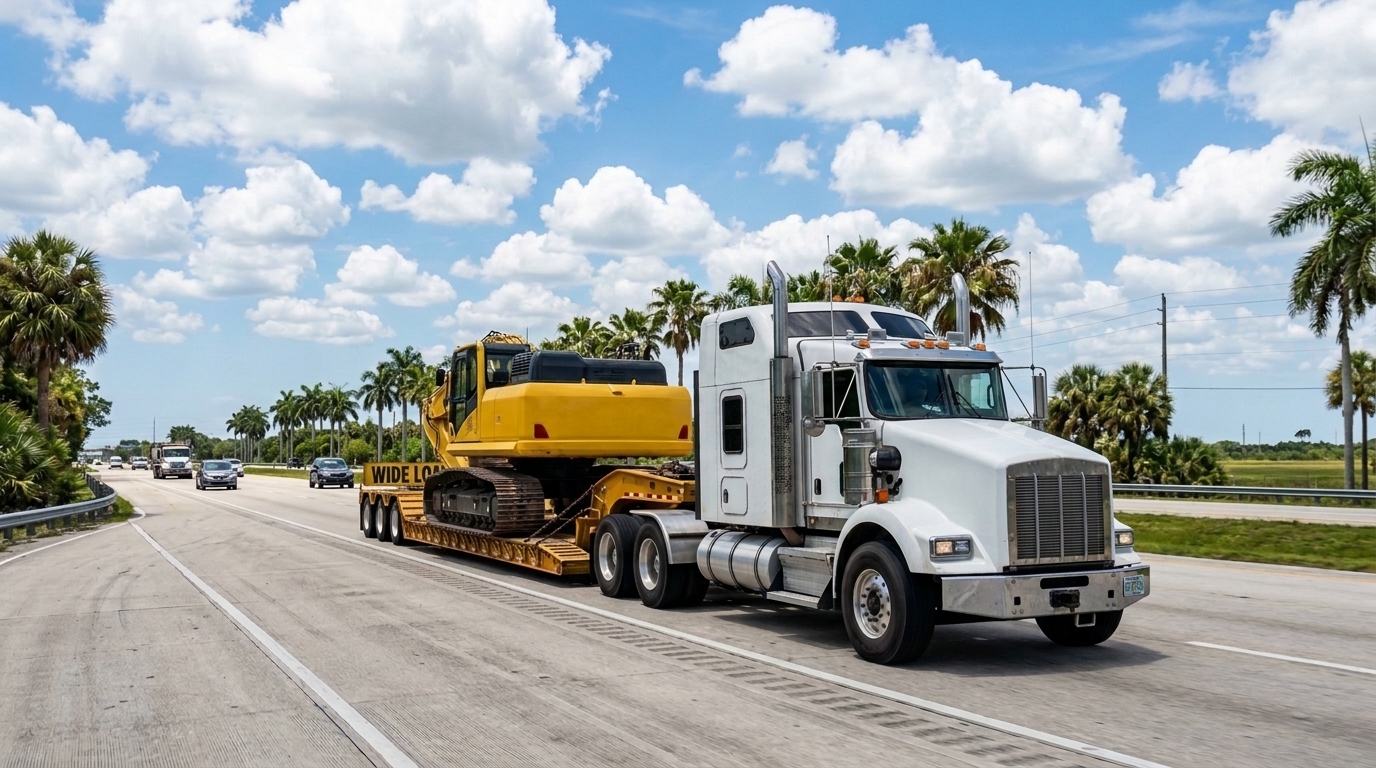
Florida Moves Freight Differently
Florida is one of the most active states for heavy and oversize hauling in the country, and it does things a little differently than most. The combination of a mild year-round climate, a massive construction market, active military installations, citrus and agriculture equipment, and a growing renewable energy sector means Florida’s roads see a constant flow of oversized and overweight loads — everything from oilfield equipment coming off barges in Port Everglades to modular building sections heading to South Florida construction sites.
But Florida has some quirks that catch out-of-state carriers flat-footed. The state uses its own Florida Axle Weight Table, which allows heavier tandem axles than the federal standard. The Florida Turnpike is covered by your FDOT permit only if the Turnpike is on your permitted route. FDOT maintains a specific permit route network, and loads going off that network require individual bridge analysis for every non-network structure. And Florida takes permit violations seriously — enforcement at weigh stations and portable checkpoints is active statewide.
If you’re moving an oversize or overweight load through Florida — whether you’re an in-state carrier or hauling from out of state — this guide covers what you need to know to do it legally and efficiently.
Florida Legal Weight Limits: How the Florida Axle Weight Table Works
Most carriers who’ve hauled heavy in other states are familiar with the Federal Bridge Formula — the federal weight-distance formula that governs legal axle weights on interstate highways. Florida uses its own Florida Axle Weight Table in Fla. Stat. 316.535, which sets limits by the distance between axles. It’s more favorable than the federal standard on tandem axles — but it does not raise the 80,000 lb gross cap.
Standard Legal Limits Without a Permit
| Single axle | 20,000 lbs |
| Tandem (2 axles spaced 8 feet or less apart) | 40,000 lbs |
| Groups of 3+ axles | Set by the 316.535(3) distance table and bridge formula (e.g., 44,140 lbs at 9 feet, up to 66,610 lbs at 36 feet) |
| Gross Vehicle Weight (all public roads) | 80,000 lbs, including all enforcement tolerances |
FDOT’s published weight tables include a 10% scale tolerance on axle weights (Fla. Stat. 316.545(2)(a)), so you’ll see scaled figures like 22,000 lbs single and 44,000 lbs tandem. The tolerance does not raise the 80,000 lb gross limit.
80,000 lbs Is the Cap on Every Road
Don’t let anybody tell you Florida lets you run over 80,000 lbs gross on state roads without a permit. It doesn’t. Fla. Stat. 316.535(4) caps gross weight at 80,000 lbs on the Interstate system, and 316.535(5) applies the same 80,000 lb cap — including all enforcement tolerances — on highways that aren’t interstates. Where Florida’s table helps you is on axle weights (especially tandems), not on gross weight.
When You Need an Overweight Permit in Florida
An overweight permit is required when your truck exceeds:
- 80,000 lbs gross vehicle weight on any public road, OR
- The gross weight allowed by the 316.535 distance table for the spacing between your first and last axles, OR
- The individual axle and axle-group limits listed above
A useful rule of thumb: if you’re over 80,000 lbs gross, or over the table weight for your axle spacing, you need a permit. If you’re in doubt, call FDOT or work with a permit service before you load the truck.
Florida Oversize Dimensions: What Triggers a Permit
Florida’s oversize thresholds are aligned with federal standards on width and height, making the state relatively straightforward on those dimensions — but Florida’s length rules work differently than most folks expect: the limits apply to the trailer, not the whole rig.
Legal Dimensions Without a Permit in Florida
| Width | 8 feet 6 inches (102 inches) |
| Height | 13 feet 6 inches |
| Length (straight truck) | 40 feet |
| Length (semitrailer) | 48 feet; up to 57 feet if kingpin to rear axle is 41 feet or less (except on restricted roads) |
| Length (truck-trailer combination) | 68 feet |
| Length (tractor-semitrailer overall) | No overall limit — trailer limits apply |
| Overhang (rear) | 10 feet |
| Overhang (front) | 3 feet |
Under Fla. Stat. 316.515(3), length limits apply to the semitrailer or trailer — not to the truck tractor or the overall length of a tractor-semitrailer combination. So it’s your trailer length (and load overhang) that decides whether you need a length permit, not how long the whole rig measures out.
What Happens at Each Width Threshold
These come straight from FDOT rule 14-26.012(7), F.A.C.:
Over 8 feet 6 inches up to 10 feet wide: Oversize permit required. No escort. Flags required. Daytime movement only.
Over 10 feet up to 12 feet wide: No escort required. Flags, “OVERSIZE LOAD” warning signs, and warning lights are required. Daytime movement only, no holidays.
Over 12 feet up to 14 feet wide: At least one qualified escort at all times. Flags, signs, and warning lights required; daytime only, no holidays. Two escorts are required on lanes narrower than 12 feet, bridges under 30 feet curb to curb, and high-traffic roads — unless the load has at least four warning lights (two front, two rear). No movement in congested areas during peak traffic hours unless your permit specifically allows it.
Over 14 feet up to 16 feet wide: Trip permits only. Two qualified escorts, one front and one rear, at all times. Daytime only, no holidays, and no movement in congested areas during peak hours. Two-lane roads can’t be used as connectors when a viable four-lane route exists.
Over 16 feet wide: Trip permits only, restricted to local moves, and subject to review by FDOT’s District Traffic Engineering Office. Two law enforcement escorts are required on state-maintained roads (other than limited access facilities); on limited access facilities it’s two qualified escorts in daytime, or one law enforcement plus one qualified escort at night.
Height: Florida’s Bridge Challenges
Florida’s legal height limit of 13 feet 6 inches matches the federal standard. Above that, you need a permit. But height is where Florida’s infrastructure creates unique challenges.
Florida has an enormous number of bridges — the state’s geography, with its coastlines, rivers, bays, and estuaries, means bridges are everywhere. Urban areas like Miami, Tampa, Jacksonville, and Orlando have dense highway interchange systems with multiple stacked structures. Older bridges in rural parts of the state may have lower clearances than modern highway structures.
For loads over 14 feet tall:
- FDOT will route-clear your load against its bridge database before issuing a permit
- A physical height pole survey (where an escort vehicle drives the route ahead of your load with a measuring device) may be required
- Urban routes through Miami, Tampa, and Orlando require particular attention to interchange clearances
- Coastal causeways connecting barrier islands often have lower clearances than mainland highways
Critical Florida height detail: The MacArthur Causeway (I-395) connecting Miami to Miami Beach has clearance restrictions that affect overheight loads heading to or from the Port of Miami. If your load is coming off or going to PortMiami and it’s over 14 feet tall, route planning needs to account for this — don’t assume the most direct route is available.
FDOT’s Permit Route Network
Florida’s permitting system is built around an approved permit route network — a set of designated state roads pre-cleared for oversize and overweight loads within certain dimension ranges. If your load and route fall within the network parameters, you get faster permit processing because FDOT has already done the bridge analysis for those roads.
Why the Network Matters
Staying on the FDOT permit route network:
- Significantly speeds up permit processing (often same-day for routine loads)
- Reduces or eliminates the need for individual bridge analysis on your route
- Is generally required for routine (non-superload) oversize permits
Going off the network — using county roads, secondary state roads not on the permit network, or taking routes that deviate from FDOT’s pre-cleared paths — triggers individual bridge analysis for every non-network structure on your route. For a 50-mile off-network segment with 20 bridges, that’s 20 individual structure reviews, and the processing time and cost reflect it.
Planning Routes on the FDOT Network
FDOT makes its permit route network available through its Permit Application System (PAS), which includes a GIS routing feature, along with the overweight routing maps on the FDOT State Permit Office page. Before applying for a permit, carriers and permit services can check whether their proposed route uses network roads and identify any off-network segments.
If you’ve got questions while you’re applying, the FDOT State Permit Office is at (850) 410-5777, Monday through Friday, 8:00 AM to 5:00 PM Eastern.
Practical advice: If your route has any flexibility, design it around the FDOT permit network. Even a modest detour to stay on network roads can save days of processing time and meaningful fees on a multi-bridge analysis. For carriers who regularly run heavy loads in Florida, knowing which corridors are network roads is genuinely valuable operational knowledge.
The Florida Turnpike: Covered by Your FDOT Permit
The Florida Turnpike is operated by Florida’s Turnpike Enterprise, which is part of FDOT. Under FDOT rule 14-61.0015(3), F.A.C., vehicles and loads over the legal dimensions in Fla. Stat. 316.515 are prohibited on the Turnpike System except under a special hauling permit issued by FDOT under Chapter 14-26 — which is the same oversize/overweight permit you get through PAS. (The separate Turnpike Tandem Permit is only for tandem trailer / longer combination vehicle operations.)
If your route includes any portion of the Turnpike — the mainline Turnpike (SR 91) from Wildwood to Florida City, or connecting roads like the Homestead Extension, Sawgrass Expressway, or Veterans Expressway — make sure those segments are on the route in your FDOT permit. Your permit only covers the route it lists.
Tip for South Florida moves: Many routes between South Florida destinations (Port Everglades, Miami, Fort Lauderdale, West Palm Beach, and surrounding areas) use the Turnpike as the most practical corridor. If your route naturally uses the Turnpike, build it into your permit route from the start rather than detouring on and off it.
Escort Requirements in Florida
Florida’s escort (pilot car) requirements follow a pattern similar to most southeastern states, with some Florida-specific details.
Standard Florida Escort Requirements by Width
| Up to 10 feet | No escort; flags required; daytime only |
| Over 10 feet to 12 feet | No escort; flags, warning signs, and warning lights required; daytime only, no holidays |
| Over 12 feet to 14 feet | At least one escort; two on lanes under 12 feet, bridges under 30 feet curb to curb, or high-traffic roads (unless the load has 4 warning lights) |
| Over 14 feet to 16 feet | Two escorts, front and rear; trip permits only |
| Over 16 feet | Local moves only; District Traffic Engineering review; two law enforcement escorts on state-maintained roads |
Source: FDOT rule 14-26.012(7), F.A.C.
These are the baseline requirements. Specific permits may impose stricter escort requirements based on route characteristics — a load that’s 12 feet wide traveling through downtown Orlando or on a two-lane rural state road may require additional escorts even if the baseline width requirement wouldn’t trigger them.
Escort Vehicle Requirements
Florida requires escort vehicles to be equipped with:
- High-intensity warning lights (amber/yellow, visible from at least 500 feet)
- “OVERSIZE LOAD” sign on the front (front escort) and rear (rear escort)
- Two-way radio for communication with the load vehicle
- Orange flags minimum 18 inches square on all four corners
- Safety vest for the escort operator when outside the vehicle
Florida also requires escort operators to have a valid Florida driver’s license. For loads requiring law enforcement escorts, the carrier coordinates with FDOT and the applicable law enforcement agency — Florida Highway Patrol is typically involved for superloads on state roads.
Escort Operator Qualifications
Under Rule 14-26.012(2), F.A.C., a Florida qualified escort must:
- Be at least 18 and hold a valid driver’s license from their home state
- Complete an 8-hour defensive driving course (or hold a current Class A, B, or C CDL)
- Complete an 8-hour pilot/escort flagging course from an FDOT-approved vendor
- Carry proof of those courses on board
- Requalify every 4 years with a 4-hour refresher course
Out-of-state escorts: Florida accepts escorts qualified by another state if that state’s standards are equal to or stricter than Florida’s and the escort was qualified or requalified within the past four years. Confirm your escort’s home-state qualification meets that bar before the move. This is a planning item, not a last-minute detail.
Travel Restrictions in Florida
Florida doesn’t have northern-style spring weight restrictions from freeze-thaw cycles, but it does have travel restriction windows for oversize loads.
Daylight-Only Travel
Florida restricts oversize loads to daylight travel — generally defined as 30 minutes before sunrise to 30 minutes after sunset. Night travel for oversize loads requires special authorization, which is rarely granted except for extraordinary circumstances.
Sunrise and sunset times vary significantly in Florida by season and by location — from the Panhandle (which is in the Central Time Zone) to South Florida. Know your specific travel window for your route and date.
Weekend and Holiday Restrictions
Florida restricts oversize load travel on:
- Major national holidays: No oversize movement on Memorial Day, Fourth of July, Labor Day, Thanksgiving, Christmas, and New Year’s Day
- Holiday weekends: Restrictions often extend to the Friday before and Monday after major holidays
- Specific weekends in high-traffic corridors: During peak tourist travel periods — especially around spring break, Daytona 500 weekend, and major events — FDOT may issue additional oversize movement restrictions on heavily traveled corridors like I-4 and I-95
Florida’s tourism-driven traffic patterns mean that certain corridors (I-4 between Tampa and Orlando, I-95 on the southeast coast, US-1 through the Keys) see restrictions during high-season weekends that don’t appear in other states. If you’re planning a move on an I-4 corridor during a major event weekend, verify whether oversize restrictions are in place.
Rush-Hour Restrictions in Urban Areas
Florida’s major metros impose rush-hour blackout windows for oversize loads:
Miami-Dade, Broward, and Palm Beach Counties:
- No oversize loads on I-95, I-75, and major urban corridors: 7:00 AM – 9:00 AM and 4:00 PM – 6:00 PM, Monday through Friday
Tampa Bay area (Hillsborough, Pinellas, Pasco):
- No oversize loads on I-275, I-75, and the Gandy Bridge corridor: 7:00 AM – 9:00 AM and 4:00 PM – 6:30 PM, Monday through Friday
Orlando metro (Orange, Seminole, Osceola counties):
- No oversize loads on I-4 and SR 408 during peak hours: 7:00 AM – 9:00 AM and 4:00 PM – 7:00 PM, Monday through Friday
Jacksonville:
- No oversize loads on I-10 and I-95 through the Springfield/downtown corridor: 7:00 AM – 9:00 AM and 4:00 PM – 6:00 PM, Monday through Friday
Plan your urban corridor timing carefully. A move that could roll right through at 2:00 PM becomes a compliance problem at 4:30 PM. When scheduling arrival and departure times, build buffer time to clear metro areas before rush-hour restrictions kick in.
Florida Superloads: Exceeding Routine Permit Limits
FDOT lets customers self-issue trip permits in PAS (using the GIS routing feature) for loads up to 16 feet wide, 18 feet high, 150 feet long, and 200,000 lbs (140,000 lbs for self-propelled equipment). Go over any of those and your permit needs review by the State Permit Office — and the heavier and wider you get, the more engineering and bridge review you’re looking at.
The Florida Superload Process
- Submit application to FDOT through the online permit system, flagging the load as exceeding routine limits
- Bridge analysis: FDOT engineers evaluate each bridge on your proposed route against your specific axle weights, spacings, and gross weight. This is the most time-consuming part — for a long route with many bridges, it can take 2 to 4 weeks.
- Route modifications: If a bridge can’t handle your load, FDOT will suggest alternative routes or require additional axles to redistribute weight. Flexibility on routing helps.
- Law enforcement coordination: Florida Highway Patrol escort is typically required for very wide or very heavy superloads. The carrier coordinates with FHP through FDOT.
- Permit issuance: Once engineering review is complete and all conditions are confirmed, the permit is issued with detailed restrictions.
Lead time for Florida superloads: Budget 15 to 30 business days from application submission to permit issuance for complex superload moves. If your load involves both extreme width and extreme weight, or if it requires off-network routing through areas with older or more fragile bridge structures, process times can run even longer.
Don’t start a superload move without your permit in hand. There’s no grace period, and “the permit is in review” is not a legal defense at a checkpoint.
Florida Permit Fees
FDOT’s permit fee structure is based on the type of permit and the dimensions or weight of the load.
Oversize Permit Fees (Approximate)
Per FDOT’s fee schedule in rule 14-26.008, F.A.C. (truck and semi-tractor-trailer loads):
- Trip permit (10 days), overdimension: $5 up to 12 feet wide / 13 feet 6 inches high / 85 feet long; $15 up to 14 feet wide / 14 feet 6 inches high / 95 feet long; $25 up to 14 feet wide / 18 feet high / 120 feet long, and $25 for anything over those
- Trip permit, overweight: charged per mile (in 25-mile increments) — from $0.27/mile up to 95,000 lbs, rising by weight class to $0.47/mile up to 162,000 lbs; above that it’s $0.003 per 1,000 lbs per mile. Overweight permits over 80,000 lbs add a $3.33 administrative cost, and a $5 transmission fee may apply
- Annual (12-month) multi-trip permits: overdimension $20 / $150 / $250 by dimension tier; overweight $240 (up to 95,000 lbs) to $500 (up to 199,000 lbs)
- Route-specific (3-month) multi-trip permits: also available, $5 to $250 depending on class
FDOT’s own example: a 112,000 lb load going 67.5 miles is billed as 75 miles × $0.32 + $3.33 = $28.00, plus the $5 transmission fee when applicable.
Florida’s permit fees are generally on the lower end compared to states like California or New York. The larger cost variable for Florida moves is often the escort requirement and, for superloads, the engineering review process.
Annual Permits
Florida offers annual permits for carriers who regularly move loads of consistent dimensions and weights. If you’re running the same route with the same equipment configuration on a weekly basis, an annual permit eliminates the need to buy a new single-trip permit every time. Annual permits are subject to the same route restrictions and travel restrictions as single-trip permits — they just don’t need to be re-issued each trip.
Annual permits also require renewal before expiration. Mark your renewal date and don’t let them lapse — an expired annual permit is the same as no permit.
Common Mistakes Carriers Make in Florida
Leaving the Turnpike Off Your Permitted Route
Your FDOT permit covers the Turnpike — but only the route it lists. If you hop on the Turnpike and it isn’t on your permit route, you’re off-permit. If your route touches the Turnpike, put it on the permit.
Not Accounting for the Florida Axle Weight Table
The 80,000 lb gross cap applies on every Florida public road, interstate or not. Where the Florida Axle Weight Table matters is axle weights: tandems spaced 8 feet or less apart get 40,000 lbs, and groups of three or more axles are limited by the distance between them. Not knowing the table is a compliance risk in both directions — you might be loading lighter than you need to on your tandems, or you might be over on a tight axle group even though you’re under 80,000 gross.
Not Checking Your Escort’s Qualifications
Florida accepts out-of-state escort qualifications only when the home state’s standards are equal to or stricter than Florida’s, and only if the escort qualified or requalified within the past four years. Don’t assume. Confirm your escort’s paperwork meets Florida’s rule before they arrive, and make sure they carry proof of their courses on board.
Ignoring Urban Metro Rush-Hour Windows
South Florida and the I-4 corridor are busy every day. An oversize load that gets through most of the route fine can end up stopped or cited because it entered a restricted urban corridor during the wrong two hours of the day. Build your schedule around the metro blackout windows, not around them.
Not Flagging Load Dimensions Accurately
FDOT permits are issued based on the dimensions you provide. If your load is actually 13 feet 6 inches wide and you told FDOT it was 12 feet wide, you’re operating out of compliance with your permit even though you have a permit in your hand. Measure accurately. If there’s any uncertainty about your height (especially — measure ground to highest point), measure before you load, not after.
FAQ
Q: What is the legal weight limit in Florida without a permit? A: Florida caps gross vehicle weight at 80,000 lbs on all public roads — interstate and non-interstate — including all enforcement tolerances (Fla. Stat. 316.535(4)-(5)). Single axles are limited to 20,000 lbs. Two axles spaced 8 feet or less apart are limited to 40,000 lbs under the 316.535(3) distance table, and groups of three or more axles are governed by that same distance table and the bridge formula. FDOT’s published weight tables include a 10% scale tolerance on axle weights, but the 80,000 lb gross cap still applies.
Q: Do I need a separate permit for the Florida Turnpike? A: No, not for a standard oversize or overweight load. Florida’s Turnpike Enterprise is part of FDOT, and under FDOT rule 14-61.0015(3), F.A.C., oversize vehicles may use the Turnpike System under a special hauling permit issued by FDOT under Chapter 14-26 — the same FDOT permit you get through PAS. Just make sure the Turnpike segments are on the route in your permit. The separate Turnpike Tandem Permit only applies to tandem trailer (longer combination vehicle) operations.
Q: What are Florida’s legal oversize dimensions without a permit? A: In Florida, a load is oversize — and requires a permit — when it exceeds 8 feet 6 inches wide, 13 feet 6 inches tall, a semitrailer longer than 48 feet (or up to 57 feet when the kingpin-to-rear-axle distance is 41 feet or less, except on restricted roads), a straight truck longer than 40 feet, a truck-trailer combination longer than 68 feet, or 80,000 lbs gross vehicle weight. Florida has no overall length limit for a tractor-semitrailer combination — the length limits apply to the trailer itself.
Q: How fast can I get a Florida overweight or oversize permit? A: FDOT processes most routine overweight and oversize permit applications through its online permitting system same-day or within 24 hours. Superloads — loads requiring bridge analysis or special routing — take significantly longer, often 5 to 15 business days depending on complexity. Custom Permits handles Florida oversize and overweight permits regularly and can often get routine permits issued the same day you call.
Q: Does Florida have spring weight restrictions? A: Florida does not have the same seasonal spring thaw weight restrictions that northern states impose, because Florida’s climate doesn’t produce freeze-thaw road damage cycles. However, Florida does post reduced weight limits on certain roads following heavy rain events or when specific bridges and road segments require protection. Always check for posted weight limit signs and current FDOT advisories before running an overweight load.
Q: What routes are available for oversize loads in Florida? A: FDOT maintains an approved permit route network for oversize and overweight loads. These routes are pre-cleared for certain load dimensions and weights and allow for faster permit processing. Loads that must travel off the FDOT permit route network require individual bridge analysis for each non-network structure on the route. For most oversize moves, routing on the FDOT network is significantly faster and cheaper than requesting an off-network route.
Get Your Florida Permit Right the First Time
Florida’s oversize and overweight permit system has more moving parts than most carriers expect: the FDOT permit route network, the Florida Axle Weight Table, Turnpike routing, urban metro restrictions, and strict enforcement at permanent and portable weigh stations across the state.
Custom Permits has been running Florida oversize and overweight permits for carriers of all sizes since 1977. We know Florida’s permit network, we know which routes need extra lead time, and we know how to build your FDOT permit route — Turnpike included — so you’re covered statewide — not just on part of your route.
If you’ve got a Florida move coming up, call us at 614-351-1740 or contact us online. Tell us your dimensions, your route, and when you need to roll. We’ll get your paperwork handled so you can keep moving.
Need Permits? We've Got You Covered.
Whether you need a single trip permit or manage a fleet running 48 states, Custom Permits has been getting it done since 1977. Order online or give us a call — we'll take care of you.