
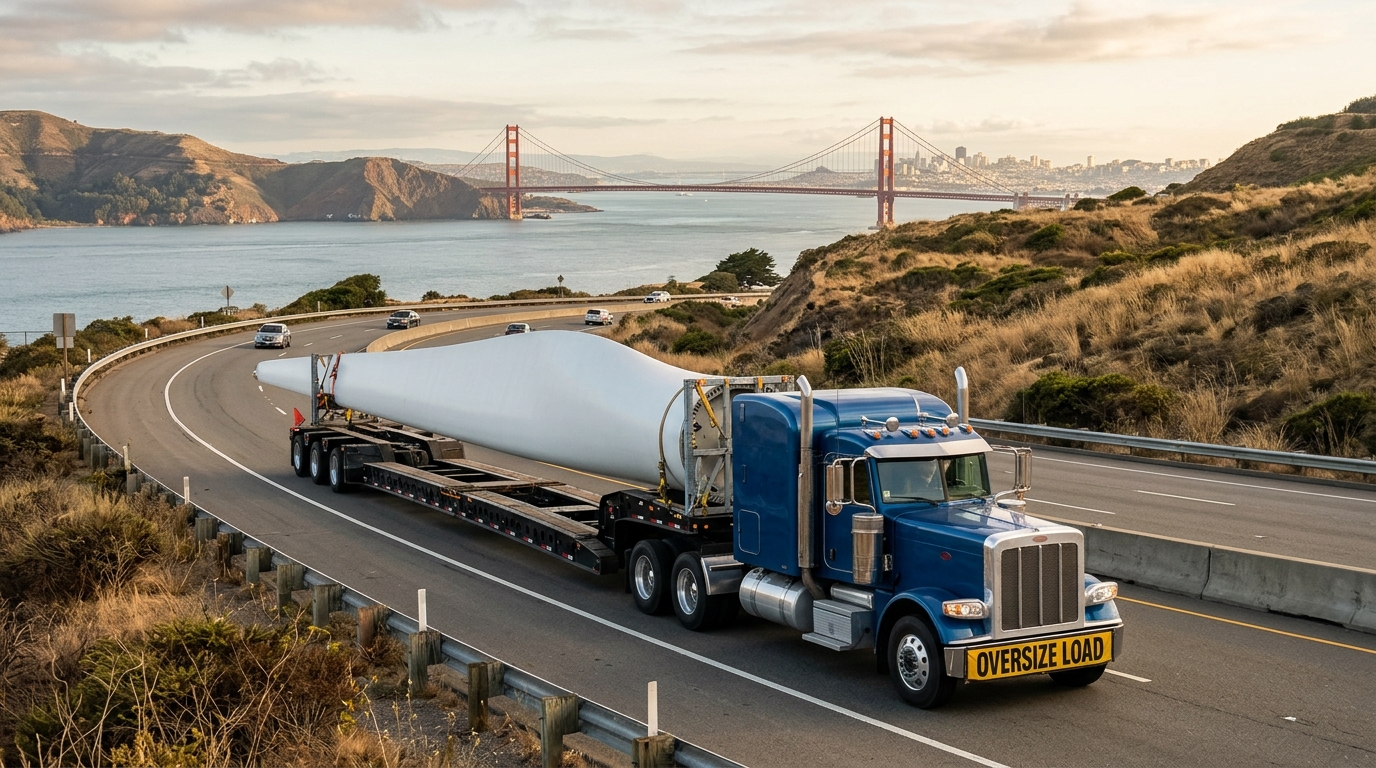
California Doesn’t Make It Easy — But That’s Kind of the Point
If you’ve hauled oversize or overweight loads through more than a handful of states, you already know: California does things its own way. The Golden State moves a staggering amount of freight — agricultural products flowing out of the Central Valley, construction equipment heading to Bay Area job sites, wind turbine components rolling through the desert passes, and port containers streaming out of Long Beach and Los Angeles every single hour of the day.
All that freight has to share the road with 40 million residents and some of the most congested highways in America. So yeah, Caltrans takes their oversize/overweight permitting seriously. They’ve built a system that’s thorough, detailed, and — once you understand how it works — actually pretty logical.
Here’s everything you need to know to haul OS/OW loads legally through California in 2026.
California Legal Size and Weight Limits
Before you even think about permits, you need to know what triggers the need for one. California legal limits for vehicles on public roadways are:
- Width: 8 feet 6 inches
- Height: 14 feet 0 inches
- Length (single vehicle): 40 feet
- Length (semitrailer): 48 feet (or 53 feet on STAA-designated routes)
- Length (truck-tractor/semitrailer combo): 65 feet overall
- Gross vehicle weight: 80,000 pounds
- Single axle weight: 20,000 pounds
- Tandem axle weight: 34,000 pounds
Exceed any one of those limits and you need a Caltrans transportation permit before you roll. And here’s the first thing that catches a lot of out-of-state carriers off guard: your load must be non-reducible to qualify for a permit. That means if you could reasonably break the load down and haul it legally, Caltrans will deny the permit. They’re not going to give you a permit just because it’s more convenient to haul everything in one trip.
The Non-Reducible Load Requirement
This is where California differs from a lot of states, and it’s worth understanding before you apply for anything.
A non-reducible load is one that, if separated into smaller loads, would either:
- Compromise the intended use of the vehicle or load — meaning it can’t do what it’s supposed to do if you take it apart
- Destroy the value of the load or vehicle — meaning disassembly would render it useless
Think construction equipment that can’t be broken down, manufactured housing, bridge beams, turbine blades, oversized industrial components. Those are non-reducible. A flatbed stacked with lumber that happens to be a little too wide? That’s reducible, and Caltrans won’t permit it.
If you’re ever uncertain whether your load qualifies, call the Permits Office at (916) 322-1297 before you submit an application and waste everybody’s time. They’ll tell you straight.
California Permit Types and What They Cost
Caltrans offers six different permit types, and the fees are refreshingly straightforward compared to some states:
Single-Trip Permit — $16
The workhorse of California OS/OW permitting. A single-trip permit covers one-way travel from a single origin to a single destination. It’s valid for seven consecutive days from the effective date.
There are actually two flavors:
- Single Trip I — For loads that need a rider form, require Resident Engineer approval, or where the carrier doesn’t provide a route (Caltrans develops one for you). These take additional processing time.
- Single Trip II — Everything else. These are more straightforward and process faster.
Maximum dimensions on a single-trip permit depend on the route colors (more on that in a minute), but in general:
- Width: Up to 14 feet on most routes, up to 15 feet without CHP escort on green/blue/brown routes, up to 16 feet on yellow routes
- Height: Varies — your loaded height must clear the lowest structure on your permitted route by at least 3 inches
- Length: Up to 135 feet
- Weight: Up to Purple Chart Weight (California’s maximum weight classification)
Important: A single-trip permit covers one direction only. If you need to return the same way with an extralegal vehicle, you need a separate permit for the return trip. The road may have different conditions, clearances, or alignments in the other direction.
Annual Permit — $90
If you’re running regular OS/OW loads in California, the annual permit is where the math starts working in your favor. At $90 for a full year, it pays for itself after just six trips compared to single-trip permits.
Annual permits are more restrictive on dimensions:
- Width: Up to 12 feet 0 inches
- Height: 14 feet 0 inches (legal height — no overheight on annual permits)
- KPRA (Kingpin to Rear Axle): 40 feet 0 inches maximum
- Weight: Legal, Green, and Purple Chart Weight
The big trade-off: annual permits cannot travel on red routes. If your regular runs take you through any red-route segments, you’ll need single-trip permits for those loads instead.
Annual permits must be renewed before expiration — allow at least 14 business days for processing. You can submit renewals up to 60 days before your permit expires.
Repetitive Permit — $90
The repetitive permit is basically a single-trip permit you can use over and over for the same load, same route, on a repeated basis. Think delivering the same overwidth pipe to the same construction site every week for three months.
- Width: Up to 12 feet 0 inches
- Height: Up to 14 feet 6 inches
- Length: Up to 90 feet 0 inches
- Duration: Up to 90 days
This is a great option when you’ve got a project running and you’re hauling the same kind of load to the same place regularly.
Sea Container Permit
A specialized permit for 4-axle tractor/3-axle trailer combinations hauling intermodal cargo containers on state highways near the Port of Los Angeles and Port of Long Beach. Maximum overall length is 65 feet with a KPRA of 40 feet maximum.
If you’re doing port work in Southern California, this is likely the permit you need.
Variance Permit
When your load exceeds what even a standard single-trip permit can cover, you’re in variance territory:
- Width: Over 15 feet 0 inches
- Height: Over 17 feet 0 inches
- Length: Over 135 feet 0 inches
- Or on special hauling equipment that exceeds Caltrans’ standard weight classification
Variance permits involve additional review, route engineering, and coordination. Processing takes longer, and you may need a route inspection certification before Caltrans will issue the permit. For variance load questions specifically, call (916) 323-2893.
Motorsport Permit
A niche permit for vehicles going to ACCUS (Automobile Competition Committee for the United States) sanctioned events at authorized locations. Most truckers won’t need this one, but it exists.
California’s Color-Coded Route System
Here’s where California gets truly unique. Instead of just listing restricted roads like most states do, Caltrans categorizes every state highway segment by color: green, blue, brown, yellow, and red. Each color indicates what dimensions that road segment can handle and what escort requirements apply.
The color determines:
- Maximum allowable width, height, and weight on that segment
- Whether you need pilot cars and how many
- Whether you need CHP escort
- Travel time restrictions on that segment
When you apply for a single-trip permit, Caltrans routes your load along segments that can accommodate your specific dimensions. If your load exceeds the thresholds for a particular color, you may need pilot cars, CHP escort, or both.
Red routes are the most restrictive — annual permits are flat-out prohibited on them, and single-trip loads face the tightest restrictions. If a red route stands between you and your destination, plan for additional time, cost, and coordination.
You can check route colors using the CalRoute database (calroute.dot.ca.gov), which lets you look up clearances and restrictions for specific highway segments. It’s a powerful tool, but it takes some getting used to if you’ve never used it before.
Pilot Car and CHP Escort Requirements
California’s pilot car requirements are tied to the route color system and your load dimensions. Here’s the general framework:
- Loads exceeding pilot car width/length/height thresholds on a given route color will require one or more pilot cars
- Loads wider than 15 feet, longer than 135 feet, or taller than 17 feet typically require CHP escort in addition to pilot cars
- CHP escort must be coordinated directly by the permittee — Caltrans issues the permit, but you schedule the escort with CHP yourself
Caltrans publishes detailed Single Trip Pilot Car Maps that show exactly which routes require pilot cars at which dimensions. Study these before you plan your trip — especially if you’re hauling something wide through mountain passes or urban corridors.
One more thing about pilot cars in California: they must display flashing amber warning lights while escorting, per California Vehicle Code Section 25270. Those lights must be removed or covered when the pilot car isn’t actively escorting. CHP enforces this.
Urban Curfew Zones — Don’t Get Caught
This catches more out-of-state carriers off guard than almost anything else about California.
If your load is wider than 10 feet, you’re subject to curfew restrictions in four major metro areas:
- Los Angeles
- Sacramento
- San Diego
- San Francisco
During curfew hours (typically morning and evening rush), overwidth loads simply cannot move through these zones. Period. No exceptions. Plan your travel windows accordingly, or you’ll be sitting on the shoulder waiting for the curfew to lift.
Caltrans publishes specific curfew maps for each metro area, and your permit conditions will spell out exactly when you can and can’t travel. Download those maps before you go — don’t learn about the curfew when you’re stuck in traffic on the 405.
There are also special conditions for holiday travel (certain holidays restrict or prohibit OS/OW movement) and special conditions for the San Francisco-Oakland Bay Bridge crossing.
How to Apply for a Caltrans Permit
Caltrans has moved most of the permitting process online through the Caltrans Transportation Permit System (CTPS) at ctps.dot.ca.gov. Here’s how it works:
- Log into CTPS — You’ll need to create an account if you don’t have one
- Acknowledge the permit conditions — Read them carefully, because they’re enforceable
- Enter vehicle and load information — Exact dimensions and weights, not estimates
- Select travel dates — Single trips are valid for 7 days from the effective date
- Provide route details — For Single Trip II permits, you provide the route; for Single Trip I, Caltrans develops it
- Pay by credit card — Visa, MasterCard, American Express, and Discover accepted
Processing Times
- Single Trip II permits process the fastest — often same-day or next business day
- Single Trip I permits take longer because Caltrans needs to develop or review the route
- Annual permits require a minimum of 14 business days for processing
- Variance permits take the longest due to additional engineering review
Office Hours and Contact
The Caltrans Permits Office is available Monday through Friday, 8 AM to 5 PM Pacific:
- General questions: (916) 322-1297
- Variance permits: (916) 323-2893
- Non-legal size/weight questions: (916) 654-5741
- After-hours emergencies only: (916) 653-3442
Walk-ins are by appointment only. Plan ahead if you need to visit the office in person.
Vehicle Inspection Requirements
Certain vehicles and equipment may require a Vehicle Inspection Report before Caltrans will issue a permit. This applies to:
- Four-axle tractors — require a California inspection report or an inspection appointment
- Single-axle jeeps and boosters — Caltrans inspects these before issuing permits
- Two-way units that aren’t registered — need temporary California registration, which is provided when the permit is requested
If your equipment requires inspection, get it scheduled early. Don’t wait until you need the permit tomorrow — inspection appointments take time to arrange, and no inspection means no permit.
Counterweights, Blades, and Buckets
Here’s a California-specific rule that trips up heavy equipment haulers: counterweights, buckets, and blades should not be removed from equipment for transport. If you do remove a blade from a larger bulldozer and carry it alongside on the same trailer, your permit must explicitly state “blade separated and reloaded.”
Shipping containers cannot exceed the authorized height limit, and a rear overhang of 5 feet is acceptable for empty containers but not for loaded ones.
These details matter. Get them right on your application, or you’ll be dealing with delays and re-submissions.
What Happens If You Get Caught Without a Permit
California doesn’t play around with OS/OW enforcement, and the California Highway Patrol (CHP) is very active about it. If you’re operating oversize or overweight without proper permits:
- You can be stopped and cited at any weigh station or during any roadside inspection
- Fines escalate quickly based on how far over legal limits you are
- Your load may be held until you obtain proper permitting — which means your equipment sits on the side of the road while you scramble to get paperwork in order
- Permits cannot be used to circumvent the Vehicle Code — if you’ve been placed out of service for a size or weight infraction, a permit won’t fix it
- Repeat violations affect your safety record and can impact your operating authority
The bottom line: the $16 single-trip permit fee is the cheapest insurance you’ll ever buy. The alternative is fines that can run into the thousands, plus the downtime and headache of having a load stuck on the road.
Tips for Hauling OS/OW in California
After processing thousands of California permits over the years, here’s what we’ve learned:
-
Know your exact dimensions before you apply. Caltrans requires precise measurements — not approximations. Measure your load carefully and include everything: height from ground to highest point, overall width including any overhang, and total length bumper to bumper.
-
Use CalRoute before you plan your trip. The route-clearing database tells you exactly what dimensions each highway segment can accommodate. A 30-minute check before you apply can save hours of re-routing later.
-
Build curfew windows into your schedule. If you’re hauling anything over 10 feet wide through LA, San Francisco, Sacramento, or San Diego, those curfew zones will affect your travel time. Plan for them upfront.
-
Get inspections done early. If your equipment requires a Vehicle Inspection Report, schedule it well ahead of when you need to move. This is not something you want to rush.
-
Consider an annual permit if you haul regularly. At $90 per year versus $16 per trip, the annual permit pays for itself quickly. Just remember the red-route restriction.
-
Keep your permit conditions handy. CHP officers will check them. Make sure every condition listed on your permit is being followed to the letter while you’re on the road.
-
Don’t assume your permit from another state covers California. It doesn’t. Every state issues its own OS/OW permits, and California’s requirements are unique enough that you need to understand them specifically.
Let Custom Permits Handle the California Headaches
Look, we get it — California’s permit system is a lot. The color-coded routes, the curfew zones, the non-reducible load requirements, the different permit types with different restrictions, the inspection requirements. It’s enough to make your head spin, especially if you’re an out-of-state carrier trying to figure it all out for the first time.
That’s exactly what we’re here for. Custom Permits has been helping carriers navigate California’s OS/OW permitting for years. We know the routes, we know the quirks, and we know how to get your permit processed right the first time so you’re not sitting around waiting while your load — and your schedule — goes nowhere.
Whether you need a single-trip permit for a one-time heavy haul, an annual permit for your regular California runs, or help figuring out a variance load, we’ve got you covered. Give us a call or visit easypermits.custompermits.com to get started.
Your load’s waiting. Let’s get it moving.
Need Permits? We've Got You Covered.
Whether you need a single trip permit or manage a fleet running 48 states, Custom Permits has been getting it done since 1977. Order online or give us a call — we'll take care of you.